You know what the work should feel like. You cannot always be there on command.
Every filmmaker has felt it once. The state where the frame, the cut, the silence all land on their own. The question that decides a career is whether that state arrives by luck or by design.
You have been there before. The day the edit cut itself. The take where the performance was already in the room and your only job was to not get in its way. The work came through you, faster and truer than you could explain afterward. People who watched it called it instinct. You knew it was a state.
Then the next project starts. Same camera. Same talent. Same hours. And the state will not come. You direct from the outside, managing the shoot instead of inhabiting it. The output is competent. It is also dead, and you can feel the deadness while it ships.
The gap between those two versions of you is not skill. You carry the same skill into both rooms. The gap is the state behind the work, and almost no one is taught to install it on command.
The strongest creative output does not come from effort. It comes from a specific internal architecture. A way of seeing that holds the whole story and the single frame at the same time, without strain.
Here is the part that stays hidden. You treat that state as weather. Something that visits. So you wait for it, and you protect it, and you grieve when it leaves. The state was never weather. It is an innate capability, and a capability can be installed.
You do not rise to the level of your craft. You fall to the level of the state you can hold under pressure.
What separates the filmmaker who delivers their best once from the one who delivers it on schedule is not talent. It is architecture. The deliberate installation of the state the work requires, before the day that requires it.
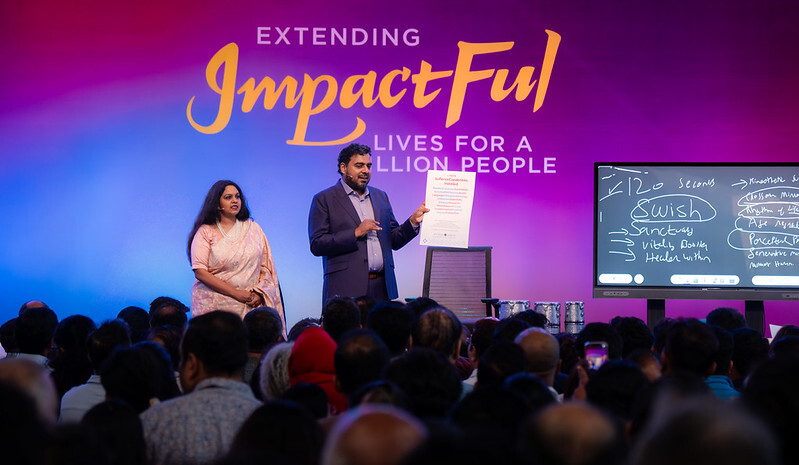
Harini was a professional playback singer who had recorded songs for A.R. Rahman and the top composers of the South. The craft was already there. Yet a lyrics stand stood planted center stage at every concert, because she feared forgetting a word in front of ten thousand people. Her attention sat on the page instead of inside the music. The state her best singing ran on was real, and it was never fully hers on command.
Antano watched one concert and asked why the stand was there. He offered to install the way she remembered. The session ran forty-five minutes. The next evening she walked on stage and left the lyrics stand backstage. Ten new songs across three languages, learned days earlier, and she did not forget a single word.
The work is not motivation. It is installation. The state the next project requires, placed inside you before the project arrives, so the day you walk on set you are already the person the work needs.
This is where time compression enters. What would take a decade of accidental good days, waiting for the state to visit, installs in a fraction of the time, because the architecture is deliberate. Predictive Intelligence reads the state your strongest work runs on, and EIT installs it on purpose.
Antano and Harini do not coach. They install. The distinction matters because coaching works on the craft you already command, and installation works on the state you have not yet learned to hold. A precise adjustment, applied at the right layer, compresses a career of waiting into a deliberate result. A × T = C™.
A short reading, written for filmmakers and media creatives. It traces how the story state forms, why it disappears, and the architecture that makes it repeatable. Enter your email and it arrives in your inbox.